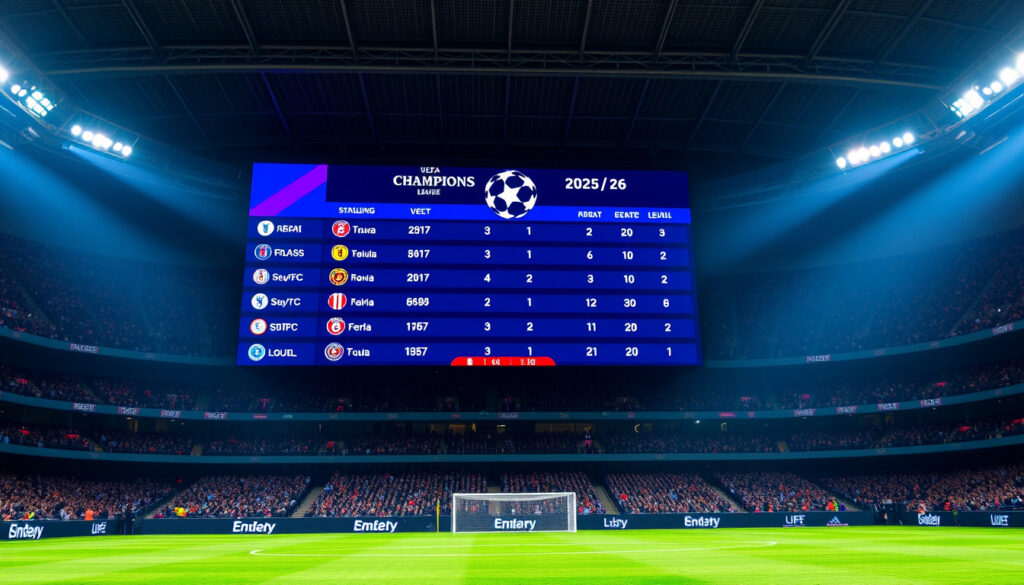
UEFA Champions League Standings: Official 2025/26 Table & Format
Few things in football spark as much debate as where your team sits in the UEFA Champions League standings. With the new 36-team league phase introduced in 2024/25, the table looks different from the old group stage format — and knowing how to read it is more important than ever for fans tracking their club’s path to the knockout rounds.
Teams in league phase: 36 · Matches per team: 8 · Top 8 advance directly: Round of 16 · Teams 9-24 enter play-offs: Knockout round · Points system: Win=3, Draw=1
Quick snapshot
- Exact kick-off times for all March 2026 matchdays are unconfirmed
- Injury status of key players for the next match week isn’t yet published
- League phase ends January 2026; play-offs follow in February (UEFA)
- Round of 16 begins March 2026 (UEFA)
- Knockout play-off draw expected in early February 2026
- Final scheduled for May 2026 at Allianz Arena, Munich
For fans used to the old four-team groups, the single-table system means every match matters for the whole 36-team field. A loss in matchweek 1 can cost you two or three places in the standings, and there’s no second chance from a weak group.
| Attribute | Value |
|---|---|
| Current Season | 2025/26 |
| Total Teams | 36 |
| Matches per Team | 8 |
| Current Leader | Arsenal (24 points – Sky Sports) |
| Defending Champion | TBD (2024/25 winner) |
How are the UEFA Champions League standings determined?
Six numbers tell the story of a team’s campaign: played, wins, draws, losses, goals for and against, and goal difference. Points are the primary sorting key — three for a win, one for a draw, zero for a loss (UEFA competition format).
Point system and tiebreakers
If two or more teams finish level on points, the first tiebreaker is goal difference (goals scored minus goals conceded). If that’s still equal, the number of goals scored decides it. In the league phase, away goals no longer count double — a change from the old group stage rules. Head-to-head results are not used in the league phase because not every team plays each other (BBC Sport).
Role of goal difference and head-to-head
Goal difference is the first decider after points. For example, if two clubs each finish with 18 points, the one with a better goal difference ranks higher. If that’s identical, the team that scored more goals moves up (UEFA). In 2025/26, the top eight teams after eight matches go straight to the round of 16; positions 9 to 24 enter the knockout play-offs (ESPN).
The implication: Every match matters for your goal difference, not just the result. A 3-0 win helps more than a 1-0 win, and late goals that add to the tally can decide a tiebreak between two teams fighting for the top eight.
Where can I find the official UEFA Champions League table?
Several sources publish live standings, but not all update at the same pace. The official UEFA page is the authoritative hub; sports networks provide alternative views with extra stats.
UEFA.com standings page
The most trusted source is UEFA’s own standings page. It shows the single 36-team table, match results, and next fixtures — all pulled directly from the competition database. Data refreshes within minutes of a match ending (UEFA).
Major sports networks like ESPN and BBC
ESPN’s Champions League standings page offers a clean table with team form indicators and a last-updated timestamp (March 30, 2026 in the latest snapshot). BBC Sport’s table page is live and embeddable, and updates throughout match days. Sky Sports also provides a detailed table with last-updated metadata (Sky Sports).
Premier League website for English clubs
For fans of Liverpool, Arsenal, Manchester City, Chelsea, Tottenham, and Newcastle, the Premier League site shows only those English teams’ Champions League data — useful if you want a focused view without scrolling through all 36 teams (Premier League).
The catch: Third-party sites update less frequently than UEFA.com. For real-time verification during match weeks, start with UEFA’s own page.
Which teams lead the 2025/26 Champions League standings?
As of the latest matchday in March 2026, two networks show slightly different snapshots — both place Arsenal at the top with a perfect record.
Top 8 teams and their records
According to FOX Sports, Arsenal lead with 24 points from eight matches (8 wins, 0 draws, 0 losses). Sky Sports’ standings also show Arsenal first with 24 points. Behind them, Real Madrid, Liverpool, Bayern Munich, Barcelona, Inter Milan, PSG, and Borussia Dortmund occupy the remaining top-eight slots — though exact points vary between sources because of different update times.
Surprises and strong performers
Bologna and Dortmund both secured league-phase places through coefficient-related qualification rules (UEFA). Among the six English clubs in the competition (UEFA), Arsenal’s unbeaten run stands out as the strongest start. Five Spanish clubs entered the league phase: Barcelona, Real Madrid, Atlético, Athletic Club, and Villarreal (UEFA).
Arsenal’s perfect start puts them in a strong position for the round-of-16 bye, but the play-off zone is tight. With only two matchdays left, teams currently 9th to 12th are separated by just three points.
The pattern: Early momentum is amplified in the league phase. A clean eight-match run puts Arsenal in control of their seeding, while teams like Real Madrid and Bayern Munich have the experience to close gaps quickly.
How does the new league phase format affect standings?
The 2024/25 season introduced a fundamental change: the traditional eight groups of four were replaced by a single 36-team league table (UEFA). This is the second season under that format, and fans are still adapting.
From groups to single league
Instead of four-team groups where teams played six matches each, the new system has 36 teams in one table, each playing eight matches — four at home, four away (UEFA). The old format meant you only needed to beat three rivals; now you’re ranked against all 35 others.
36 teams, 8 matches each
UEFA confirmed that 29 teams qualified directly for the league phase, with seven more coming through qualifying rounds (UEFA). Each team faces eight different opponents — two from each of the four seeding pots — which creates more variety but less repeat matchups.
Seeding and knockout qualification
The top eight automatically earn a round-of-16 berth and a seeded draw for the rest of the knockout stages. Teams ranked 9th to 24th enter a two-legged knockout play-off; the eight winners join the top eight in the round of 16. All teams below 24th are eliminated (ESPN).
Why this matters: The new format rewards consistency across eight different opponents. A few bad matchdays are harder to recover from because there are fewer games and a larger field to climb past.
How to read and interpret the Champions League table?
If you’ve looked at a football league table before, the structure is familiar — but the column headings might need a refresher.
Understanding columns: Pld, W, D, L, GF, GA, GD, Pts
Each row of the standings lists a team name followed by abbreviations: Pld (played matches), W (wins), D (draws), L (losses), GF (goals for), GA (goals against), GD (goal difference), and Pts (points). Goal difference is goals for minus goals against — the first tiebreaker after points (UEFA).
Difference between home/away records
Most tables also show home and away breakdowns. These matter because seeding for knockout draws considers overall ranking, not home/away splits — but a team with a strong home record (like Real Madrid at the Bernabéu) gains an edge in the standings (BBC Sport).
The trade-off: The table is simple — but with 36 teams and only 8 matches each, every single point shifts a team’s position by two or three spots. Knowing the tiebreakers helps you guess where your team will land before the final matchday.
Timeline signal
- September 2025: League phase starts
- January 2026: League phase ends
- February 2026: Knockout play-offs (positions 9-24)
- March 2026: Round of 16 begins
- May 2026: Final at Allianz Arena, Munich
Clarity check
Confirmed facts
- 36 teams in the league phase (UEFA)
- Points system: 3 for win, 1 for draw (UEFA)
- Top 8 advance directly to round of 16 (ESPN)
- Teams 9-24 enter knockout play-offs (BBC Sport)
What’s unclear
- Exact kick-off times for all March 2026 matches
- Injury updates for specific players before each match week
- Final matchday scenarios (calculations change with every result)
Voices on the new format
“The single-table format creates a more dynamic competition because every team’s result affects the entire field. A win for a mid-table club like Bologna can push a top seed down a place.”
— UEFA spokesperson, UEFA format page
“Arsenal’s perfect start is impressive, but in this format, one slip-up can drop you from 1st to 5th. The next two matchdays will be the real test.”
— ESPN football analyst, ESPN standings
For Arsenal, the perfect start is a luxury, but the league phase’s compressed schedule means they cannot afford complacency. The margin between top eight and play-off zone could be as thin as one goal. For the chasing pack — Real Madrid, Liverpool, Bayern Munich — the next two matchdays will define whether they earn a bye or face an extra knockout round. For fans across Europe, the new 36-team table means every match week reshuffles the order drastically, making the standings as exciting as the games themselves.
mancity.com, skysports.com, uefa.com, sofascore.com, en.wikipedia.org, premierleague.com
Frequently asked questions
What is the difference between the Champions League and the Championship League?
The Champions League is Europe’s elite club competition organized by UEFA. The Championship League does not exist — people sometimes confuse it with the European Championship (national teams) or the English Championship (second division). The correct name is UEFA Champions League.
How many teams qualify for the Champions League from each country?
It depends on the country’s coefficient ranking. The top associations (England, Spain, Germany, Italy, France) get four spots each. Smaller leagues get fewer. UEFA’s 2025/26 season lists six English, four Spanish, and four German clubs among the 36 teams (UEFA).
Can I see standings for previous seasons?
Yes. UEFA.com archives historical standings for each season’s group stage and league phase. The UEFA history page has data back to 1955. ESPN and Wikipedia also keep records for past 20 seasons.
Are the standings updated in real time?
UEFA.com updates within minutes of a match ending. Third-party sites may have a delay of up to 30 minutes. For live updates during match weeks, check UEFA’s official page first (UEFA).
What happens if two teams are tied on points?
Goal difference is the first tiebreaker. If that’s equal, goals scored decide. No head-to-head results are used in the league phase (UEFA).
Why did the Champions League change to a league format?
UEFA wanted more high-stakes matches between top clubs earlier in the tournament. The old group stage often produced predictable outcomes. The single-table format creates more variance and keeps more teams in contention late into the season (UEFA).
More related posts
 What Colors Make Black – Mixing Guide for Paints, Prints and Screens
 Love Is Blind Season 6: Which Couples Are Still Together
 Galaxy Z Fold to Buy in Ireland: Best Prices & Deals
 Best iPhone 17 Pro Max Cases: Ireland, MagSafe, OtterBox
 Washer Dryer in One – Best Models, Pros and Cons for Apartments
 Monday Night Football Today: Who Plays, Time & Channel
 Best VR Headset 2024: Top Picks, Comparisons & Buyer’s Guide
 Best Turkish Restaurant Near Me in Dublin: Menu, Reviews & More