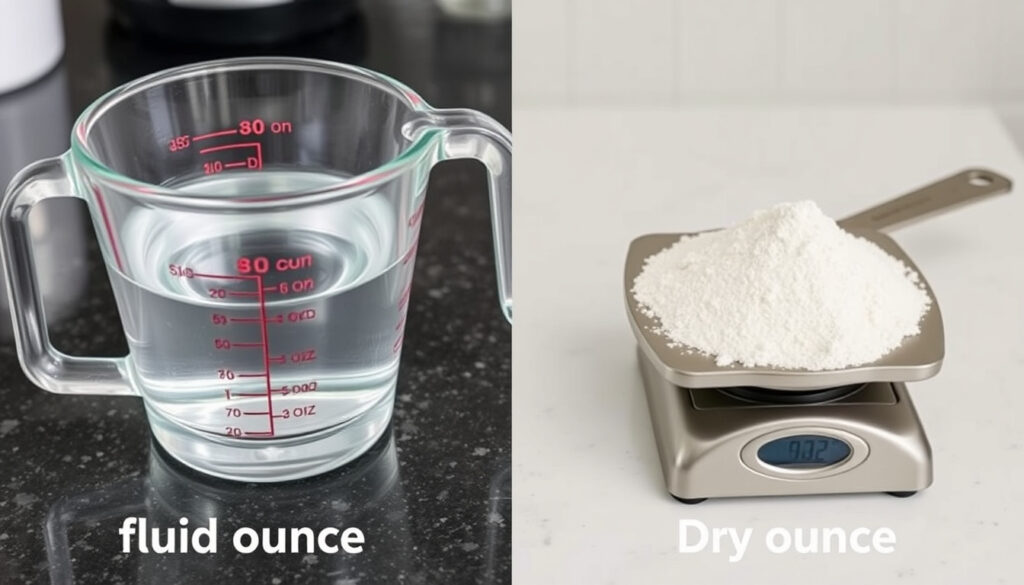
How many cups is 8 oz? Fluid ounces vs dry ounces explained
Anyone who’s pulled out a measuring cup and wondered “is this the right one?” knows the frustration of a simple question that turns complicated. The answer to “how many cups is 8 oz?” depends entirely on whether you’re measuring a liquid or a dry ingredient—and that distinction trips up even experienced home cooks; this guide walks through the fluid-ounce-to-cup conversion for water, breaks down why dry ingredients like flour and sugar give different cup amounts, and explains why yogurt counts as a wet ingredient, so you’ll never second-guess a recipe again.
1 cup (volume): 8 fluid ounces (fl oz) · 1 fluid ounce: 29.5735 mL · 8 oz flour (weight): ≈ 1.75 cups · 8 oz sugar (weight): ≈ 1.13 cups · 8 oz water (weight): 1 cup
Quick snapshot
- 8 fl oz = 1 cup (US customary) USDA Food Buying Guide
- 8 oz water (weight) = 1 cup 100 Days of Real Food
- Dry ingredient conversion depends on density; no single rule. Chef Lola’s Kitchen
- Pasta volume varies by shape and density. Mad Creations Hub
- US customary cup standardised in late 19th century Wikipedia (historical reference)
- Switch to digital kitchen scale for dry ingredients Chef Lola’s Kitchen
Six key conversions show the split between volume and weight measurements for common ingredients.
| Ingredient | Measurement | Value |
|---|---|---|
| 1 US cup | Volume (fluid oz) | 8 fluid ounces USDA Food Buying Guide |
| 1 fluid ounce | Volume | 29.5735 milliliters Wikipedia |
| 8 oz water (weight) | Volume | 1 cup (≈236.6 mL) 100 Days of Real Food |
| 8 oz all-purpose flour (weight) | Volume | ≈ 1.75 cups 100 Days of Real Food |
| 8 oz granulated sugar (weight) | Volume | ≈ 1.13 cups Chef Lola’s Kitchen |
| 8 oz shredded cheese (volume) | Volume (packed) | 2 cups (1 cup cheese ≈ 4 oz) Chef Lola’s Kitchen |
Does 8 oz make 1 cup?
What is a fluid ounce?
A fluid ounce is a unit of volume used for liquids. In the U.S. customary system, 1 cup equals 8 fluid ounces exactly USDA Food Buying Guide (official government nutrition reference). One fluid ounce is about 29.57 milliliters, and for nutrition labeling the standard is 30 mL per fluid ounce Wikipedia. So yes, 8 fluid ounces equals 1 cup—but only when measuring volume.
What is a dry ounce?
A dry ounce measures weight (mass), not volume. One dry ounce is the same as 28.35 grams. The trouble starts because many recipes write “8 oz” without specifying fluid or dry. For dry ingredients, 8 oz by weight does not always fill 1 cup—it depends on the ingredient’s density Mad Creations Hub (cooking reference).
The standard conversion for liquids
For any liquid—water, milk, oil, broth—the conversion is straightforward: divide fluid ounces by 8 Omni Calculator (conversion tool). So 8 fl oz = 1 cup, 4 fl oz = ½ cup, 2 fl oz = ¼ cup USDA Food Buying Guide.
Bottom line: If the recipe calls for 8 oz of a liquid, reach for a liquid measuring cup and fill to the 1-cup line. For dry ingredients, you need to know the specific conversion—or better yet, weigh them.
The implication: always check whether the recipe means fluid ounces or weight ounces.
Is 2 cups 8 oz?
Understanding the relationship between cups and ounces
No. Two cups is 16 fluid ounces, not 8. Since 1 cup = 8 fl oz, multiplying by 2 gives 16 fl oz USDA Food Buying Guide. This is a common mix-up: people sometimes think “2 cups = 8 ounces” because they confuse fluid ounces with weight ounces. The correct relationship: ½ cup = 4 fl oz, ¼ cup = 2 fl oz.
The implication: When a recipe says “add 2 cups of water,” you are adding 16 fluid ounces, not 8.
How many cups is 8 oz dry?
There is no single answer because dry ingredient density varies. Volume = weight ÷ density. Below are the most common kitchen conversions.
8 oz of flour in cups
One cup of all-purpose flour weighs about 4.5 oz 100 Days of Real Food (home cooking reference). Therefore, 8 oz of flour is about 8 ÷ 4.5 = 1.78 cups. Most sources round to 1¾ cups. Always use the spoon-and-level method or a scale for accuracy.
8 oz of sugar in cups
Granulated sugar is denser than flour. One cup of sugar weighs about 7 oz. So 8 oz ÷ 7 oz/cup ≈ 1.14 cups Chef Lola’s Kitchen (cooking resource). That’s roughly 1 cup plus 2 tablespoons.
8 oz of pasta in cups
Dry pasta shape affects volume. 8 oz of elbow macaroni equals about 2 cups dry, while 8 oz of spaghetti (uncooked) fills about 2 cups when measured by volume Mad Creations Hub. Because of shape variation, weighing pasta is more reliable.
8 oz of cheese in cups
Shredded cheese is measured by volume in recipes. 1 cup of shredded cheddar weighs about 4 oz. So 8 oz = 2 cups Chef Lola’s Kitchen. For cream cheese, 8 oz (one standard block) equals 1 cup.
Using a liquid measuring cup for dry flour can add up to 25% extra volume because of compression. A digital scale removes the guesswork entirely.
The trade-off: Convenience of cups vs. precision of a scale. For baking, weight beats volume every time.
Is yogurt a dry or wet ingredient?
Why yogurt is measured as a liquid
Yogurt behaves like a liquid in recipes: it pours, it fills a volume measure, and its density is close to water’s. In U.S. recipes, yogurt is always measured by volume (cups, fluid ounces), not by weight Chef Lola’s Kitchen (cooking guidance). So 1 cup of yogurt = 8 fluid ounces by volume, even though its weight is about 8.6 oz (245 g).
How to measure yogurt correctly
Use a liquid measuring cup. Scoop the yogurt into the cup and level it off with a spatula. Do not pack it down. For the same reason, sour cream and buttermilk also count as wet ingredients.
If a recipe specifies “8 oz of yogurt,” it almost always means 8 fluid ounces (1 cup), not 8 weight ounces. When in doubt, check the context: liquids are almost always volume.
The pattern: thick fermented dairy products like yogurt, sour cream, and buttermilk are always measured as liquids.
How many cups is 8 oz of water?
Converting 8 oz of water to milliliters and liters
Because water’s density is 1 gram per milliliter, 8 fluid ounces of water weighs exactly 8 oz and occupies 1 cup. In metric: 8 fl oz = 236.6 mL ≈ 0.2366 L 100 Days of Real Food. For practical kitchen use, 8 fl oz of water = 1 cup = 240 mL (the nutrition-label rounding).
So the simplest conversion in the kitchen: 8 oz of water = 1 cup. No density adjustments needed.
Ice cubes are water, but measuring by volume is tricky because of air gaps. If a recipe calls for “8 oz ice,” weigh the ice, don’t use a cup measure.
The catch: despite the simple conversion for water, always confirm the recipe’s intent to avoid mistakes.
Comparison: Fluid ounces vs dry ounces for common ingredients
Five common ingredients, one pattern: weight ounces map to different cup volumes because of density differences.
| Ingredient | 8 oz (weight) → cups | Notes |
|---|---|---|
| Water | 1 cup | Density = 1 g/mL; exact match |
| All-purpose flour | ≈ 1.75 cups | 1 cup ≈ 4.5 oz 100 Days of Real Food |
| Granulated sugar | ≈ 1.13 cups | 1 cup ≈ 7 oz Chef Lola’s Kitchen |
| Shredded cheese | ≈ 2 cups | 1 cup packed ≈ 4 oz Chef Lola’s Kitchen |
| Yogurt (volume) | 1 cup (8 fl oz) | 8 fl oz by volume, weigh ≈8.6 oz |
The pattern: Liquids (water, yogurt) map directly; dry ingredients diverge based on particle size and compaction.
How to measure 8 oz correctly (step by step)
- Identify your ingredient. Is it a liquid (water, milk, oil, yogurt) or a dry ingredient (flour, sugar, cheese, pasta)?
- Choose the right tool. For liquids, use a glass liquid measuring cup with a spout. For dry ingredients, use nested dry measuring cups (metal or plastic) or a digital scale.
- For liquids: Pour into the cup until the bottom of the meniscus hits the 1-cup line (8 fl oz). Check at eye level.
- For dry ingredients if using cups: Spoon the ingredient into the dry measuring cup (don’t scoop), then level off with a straight edge. Do not pack unless the recipe says “packed.”
- For dry ingredients using a scale: Place the measuring bowl on the scale, tare to zero, and add the ingredient until it reads 8 oz (227 g for most, but confirm with specific density).
The catch: Even with the best technique, cup measures for dry ingredients can vary by 10–20%. A scale gives identical results every time.
Quotes from trusted sources
First of all, we can help with that one: 1 cup is equal to 8 ounces (oz), 16 tablespoons (Tbsp), 48 teaspoons (tsp), or 240 milliliters (mL).
— National Institutes of Health (NIH) NIH (federal health agency)
There are 1 cup in 8 fluid ounces.
— CK-12 Foundation CK-12 (educational foundation)
Clarity: confirmed and uncertain
Confirmed facts
- 8 fluid ounces = 1 cup (US customary) USDA
- 8 oz water (by weight) = 1 cup because water density ≈ 1 g/mL 100 Days of Real Food
What’s unclear
- 2 cups = 16 fluid ounces USDA
- Conversion for dry ingredients depends on density; no single rule.
- Pasta volume varies by shape (e.g., 8 oz elbow macaroni ≈ 2 cups dry, but 8 oz spaghetti is different).
The distinction between confirmed and uncertain highlights areas where caution is needed.
Summary
The difference between fluid ounces and dry ounces is not a trivial detail—it’s the key to accurate cooking and baking. For home cooks in the U.S., the choice is clear: use liquid measuring cups for anything you can pour, and invest in a digital kitchen scale for flour, sugar, and pasta. The scale costs less than $20 and eliminates the guesswork that even experienced bakers struggle with.
unitjuggler.com, youtube.com, coda.io, dwello.in, thermoforming-machinery.com, facebook.com
Frequently asked questions
Is 8oz the same as ¼ cup?
No. ¼ cup = 2 fluid ounces. 8 oz is four times that amount (1 cup). Only if you’re talking about weight and the ingredient is extremely dense could they coincide, but as a volume rule, 8 oz ≠ ¼ cup.
How much is 8 oz of flour in cups dry?
About 1.75 cups (1¾ cups), assuming all-purpose flour spooned and leveled. Weighing is more accurate.
Is 8 oz of dry pasta 1 cup?
It depends. 8 oz of elbow macaroni equals about 2 cups dry. For long pasta like spaghetti, the volume varies. Always check the package or weigh it.
How much is 8oz in ml?
8 fluid ounces = 236.6 mL (US standard). For nutrition labeling, the rounding is 240 mL.
What is 8 ounces in litres?
8 fl oz = 0.2366 L. About 0.24 L.
1 cup 8 oz to grams for sugar?
1 cup of granulated sugar weighs about 200 g (7 oz). 8 oz of sugar by weight is about 227 g.
Is 2 oz the same as a ¼ cup?
Yes, for liquids: ¼ cup = 2 fluid ounces. For dry ingredients, 2 oz by weight is not necessarily ¼ cup (e.g., 2 oz flour ≈ 0.44 cup).
Related reading
More related posts
 Black Friday Deals 2025: Dates, Tips & Best Offers in Ireland
 Houston Rockets vs Denver Nuggets Match Player Stats
 How to Watch Thursday Night Football: Free Streams & Schedule
 Golden State Warriors vs Phoenix Suns Match Player Stats: Apr 17
 How to Make Banana Bread: Moist Recipe Guide
 Indoor Activities Near Me: Top Rainy Day Fun in Ireland
 Best Espinacas con Garbanzos Near Me in Dublin – Salamanca & More
 Women’s Cricket World Cup Standings 2025: Points Table & Qualifiers