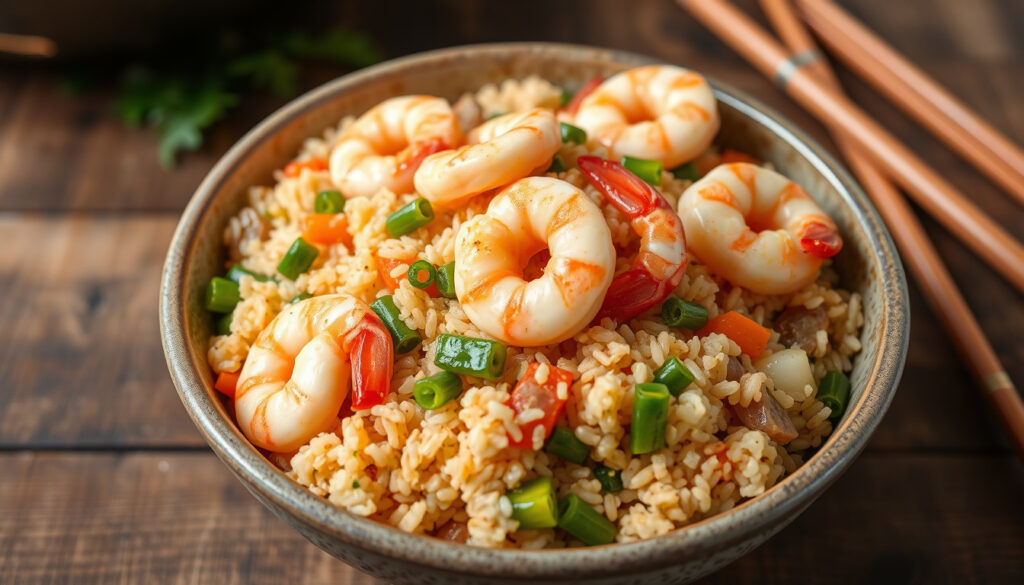
Shrimp Fried Rice Recipe: Easy, Authentic & Perfect Results
There’s something about plump, juicy shrimp tossed with fluffy, slightly charred rice that makes a weeknight dinner feel like a takeout treat. The secret to nailing that restaurant-style shrimp fried rice at home doesn’t require a fancy wok—just a few smart techniques and the right ingredients, and you’ll learn exactly how to choose your shrimp, prep your rice, and build layers of flavor in under 20 minutes.
Prep time: 10 minutes ·
Cook time: 10 minutes ·
Total time: 20 minutes ·
Servings: 4 ·
Calories per serving: ~450 kcal ·
Protein per serving: 25g
Quick snapshot
- Day-old refrigerated rice yields better texture (Smithsonian Asian Pacific American Center – culinary resource)
- High heat is critical to prevent sogginess (Simply Recipes – trusted recipe site)
- Medium- to long-grain rice is preferred over short-grain (Smithsonian Asian Pacific American Center – culinary resource)
- Whether long-grain jasmine or medium-grain Calrose is ideal
- Whether MSG is necessary for authentic taste
- Whether oyster sauce is essential or just a common enhancer
- Whether shrimp doneness timing is universally agreed
- Total cook time just 10 minutes – fast weeknight meal
- Experiment with leftover proteins like chicken or pork
- Try a smoky bacon variation for extra umami
Key facts at a glance
Six numbers that matter for this shrimp fried rice recipe:
| Attribute | Value |
|---|---|
| Calories per serving | ~450 kcal |
| Protein per serving | 25g |
| Prep time | 10 minutes |
| Cook time | 10 minutes |
| Difficulty | Easy |
| Key equipment | Wok or large skillet, high heat burner |
What ingredients do you need for shrimp fried rice?
Shrimp: fresh vs frozen
- Either fresh or frozen shrimp works; if frozen, thaw fully and pat very dry with paper towels. According to Simply Recipes (established recipe publisher), lightly coating shrimp with cornstarch helps improve texture during searing.
- Medium or large shrimp (31–40 count per pound) provide the best bite – not too tiny, not too bulky.
Rice: day-old is key
- The single most important ingredient: cold, day-old cooked rice. The Smithsonian Asian Pacific American Center (educational cultural institution) explains that cold rice firms up and separates more easily, preventing clumps.
- Jasmine rice is explicitly favored by that same source because it stays fluffy and sturdy.
Vegetables: peas, carrots, scallions
- Frozen peas and diced carrot are classic – they add color, sweetness, and a slight crunch. Scallions are added at the end for freshness.
Aromatics: garlic, ginger
- Garlic and ginger are frequently used aromatics, as noted by I Wash You Dry (recipe blog). Mince them finely so they cook quickly without burning.
Sauces: soy sauce, oyster sauce
- Soy sauce provides salt and umami; oyster sauce adds sweetness and depth. I Wash You Dry cites both as common seasonings.
- Some recipes, like The Woks of Life (authoritative Chinese cooking blog), also use dark soy sauce for color and a pinch of turmeric.
Eggs: for texture and protein
- Eggs are scrambled separately then added back – a technique shared by Simply Recipes to keep them fluffy and not overcooked.
The takeaway: prepping each component separately gives you total control over doneness and texture.
Using the wrong rice or wet shrimp is the fastest way to turn a quick stir-fry into a sticky mess. Choosing day-old jasmine and thoroughly dried shrimp sets you up for success before the heat even hits the pan.
How do Chinese people make shrimp fried rice?
Wok hei: the smoky aroma
- Wok hei – that smoky, “breath of the wok” flavor – comes from cooking at extremely high heat. The Smithsonian Asian Pacific American Center describes a blazing hot wok as ideal for preventing sticking and improving texture.
- Home chefs can approximate wok hei by using a cast-iron skillet or carbon-steel wok on the highest burner setting, and by adding oil only after the pan is smoking.
High heat cooking
- The Woks of Life recommends heating the wok until just smoking before adding oil and shrimp. This ensures immediate searing rather than steaming.
Sequence of adding ingredients
- A typical Chinese restaurant sequence: sear shrimp → remove → scramble eggs → remove → stir-fry aromatics → add rice → push rice up sides of wok → add sauces along edges → return shrimp and eggs → toss with scallions.
- Adding soy sauce along the hot wok edge makes it sizzle and instantly perfume the rice – a trick shared by YouTube chef Ready Jet Cook (home cooking channel).
Use of lard or oil
- Traditional fried rice often uses lard for richness, but any high-smoke-point oil (peanut, canola, avocado) works well.
Common rice varieties used in China
- Long-grain rice (jasmine) is standard in southern China; medium-grain is more common in northern regions. Avoid short-grain sweet rice – it’s too sticky.
The implication: the order of cooking and the temperature are not negotiable. Skip the high heat, and you lose the signature texture and aroma.
What is the trick to making good fried rice?
Use day-old refrigerated rice
- Cold rice separates better than freshly cooked rice. Table for Two (recipe blog) calls day-old rice the best choice because it is drier and less likely to clump. If you must use fresh rice, the same source suggests reheating and drying it slightly before stir-frying.
Pat shrimp dry before cooking
- Moisture is the enemy of a good sear. Blot shrimp with paper towels until completely dry, then dust with a pinch of cornstarch per the Simply Recipes method.
Cook ingredients in batches
- Smithsonian Asian Pacific American Center warns that overcrowding the pan reduces heat retention and can make fried rice soggy. Cook shrimp and eggs first, remove, then stir-fry the rice.
Season with soy sauce along the wok edge
- Pouring sauce into the middle of the rice can make it mushy and uneven. Instead, drizzle around the hot metal edge so it caramelizes instantly.
Add scallions at the end
- Scallions lose their snap if cooked too long. Toss them in just before serving for a fresh, mild onion kick.
The pattern: every trick targets moisture control – dry rice, dry shrimp, high heat, and last-minute additions.
Home cooks who master batch-cooking and the day-old rice rule can consistently produce fried rice that rivals takeout – without any special equipment beyond a hot pan.
What this means: controlling moisture at every step is the single skill that separates takeout quality from a mushy mess.
What gives Chinese fried rice its flavour?
Soy sauce: umami and salt
- Light soy sauce adds saltiness and a pale color; dark soy sauce (used in The Woks of Life recipe) contributes a deeper color and slight sweetness.
Oyster sauce: sweetness and complexity
- Oyster sauce is a key differentiator from plain soy sauce, according to I Wash You Dry. It adds richness and a subtle caramel note.
Sesame oil: aromatic finish
- A drizzle of toasted sesame oil at the very end gives a nutty aroma that signals “Chinese takeout” to the nose.
White pepper: heat without color
- White pepper is preferred over black pepper in fried rice because it blends into the rice without dark specks, and has a slightly different floral heat.
MSG or natural glutamate sources
- MSG is commonly used in Chinese cooking to boost savoury flavor, but it is entirely optional. Many home cooks skip it and still achieve great results using oyster sauce and soy sauce.
The trade-off: oyster sauce and sesame oil together can make the dish quite rich. For a lighter version, cut the oyster sauce and rely on soy plus a pinch of sugar.
What are common mistakes when making fried rice?
Using freshly cooked rice
- Fresh rice is too moist and sticky – it clumps and turns mushy. Cold, day-old rice is the proven fix (Table for Two).
Overloading the pan
- Too many ingredients drop the pan temperature, causing the rice to steam instead of fry. The Smithsonian Asian Pacific American Center explicitly warns that overcrowding reduces heat retention.
Undercooking the shrimp
- Shrimp should be cooked only until pink and no longer translucent – about 1–2 minutes per side in a single layer. Overcrowded pans lead to rubbery shrimp (I Wash You Dry).
Adding sauce too late
- If you pour soy sauce onto cold rice, it won’t vaporize properly. Add it when the rice is already sizzling, ideally around the edge of the wok.
Skipping the egg step
- Eggs are often scrambled first and set aside. Folded back in at the end, they keep a soft, fluffy texture. Skipping or overcooking them loses an important protein layer.
The catch: most mistakes trace back to impatience – rushing to combine everything at once destroys the sear and creates steam.
Step-by-step shrimp fried rice recipe
- Prep the rice: The night before, cook jasmine rice, cool it, and refrigerate uncovered for at least 4 hours (or up to 2 days). Fluff with a fork before using.
- Prep the shrimp: Peel and devein 1 lb (450g) medium shrimp. Pat very dry, then toss with 1 tsp cornstarch, ½ tsp salt, and a pinch of white pepper.
- Mix the sauce: In a small bowl, combine 2 tbsp light soy sauce, 1 tbsp oyster sauce, 1 tsp dark soy sauce (optional), and 1 tsp sugar.
- Cook the shrimp: Heat a wok or large skillet over high heat until smoking. Add 2 tbsp oil, then sear shrimp in a single layer for 20 seconds per side (The Woks of Life technique). Remove to a plate.
- Scramble the eggs: Add a little more oil, then pour in 3 beaten eggs. Stir quickly until just set, then remove.
- Stir-fry aromatics and vegetables: Add 1 tbsp oil, then sauté 2 minced garlic cloves and 1 tsp grated ginger for 10 seconds. Add ½ cup frozen peas and ½ cup diced carrot; stir-fry 1 minute.
- Add the rice: Increase heat to high. Add 4 cups cold cooked rice, breaking up any clumps. Spread rice across the wok, let it sit untouched for 15–20 seconds, then toss. Repeat 2–3 times.
- Season along the edge: Pour the sauce mixture around the side of the wok (not directly on the rice). Toss immediately to coat evenly.
- Return shrimp and eggs: Add the cooked shrimp and eggs back to the wok. Toss to combine and heat through, about 30 seconds.
- Finish: Remove from heat, drizzle with 1 tsp toasted sesame oil, sprinkle with chopped scallions and a pinch of white pepper. Serve immediately.
Clarity check: what we know and what’s still debated
Confirmed facts
- Day-old refrigerated rice yields better texture than fresh rice. (Table for Two)
- High heat is critical for wok hei and to avoid sogginess. (Simply Recipes)
- Medium- to long-grain rice (especially jasmine) is preferred over short-grain. (Smithsonian Asian Pacific American Center)
- Overcrowding the pan reduces heat and leads to soggy rice. (Smithsonian Asian Pacific American Center)
What’s unclear
- Whether long-grain jasmine or medium-grain Calrose is ideal – both have proponents.
- Whether MSG is necessary for authentic taste – many home recipes omit it and still rate highly.
- Whether oyster sauce is essential or just a common enhancer – some cooks rely only on soy sauce.
- Whether shrimp doneness timing (1–2 minutes per side) is universally agreed – different sources give slightly different timings.
Why this matters: the confirmed facts are bedrock for any cook; the unclear points give room for personal preference without sacrificing quality.
Expert perspectives on shrimp fried rice
“Using cold rice is the number one secret to perfect fried rice.”
– Chef from Red House Spice (Chinese cooking blog)
“Bacon adds a smoky richness that mimics wok hei in a home kitchen.”
– Author from RecipeTin Eats (popular recipe site)
The pattern: both experts emphasize workarounds for home cooks – cold rice and bacon smoke – proving that wok hei can be approximated without professional equipment.
madewithlau.com, youtube.com, iwashyoudry.com, youtube.com, reddit.com, youtube.com, redhousespice.com, reddit.com
For a classic variation that also features shrimp, try this Yung Chow fried rice recipe, which adds pork and vegetables for extra depth.
Frequently asked questions
Can I use brown rice for shrimp fried rice?
Yes, but brown rice is chewier and requires a slightly longer cooking time. Use day-old brown rice for best results.
What type of shrimp is best: fresh or frozen?
Either works. Frozen shrimp is convenient and often flash-frozen at peak freshness. Thaw completely and pat dry before cooking.
How do I reheat leftover fried rice without drying it out?
Spread in a single layer in a hot wok or skillet with a splash of water. Cover for 30 seconds to steam, then uncover and toss to re-crisp.
Is shrimp fried rice gluten-free?
Not with traditional soy sauce. Use tamari or coconut aminos to make it gluten-free. Check oyster sauce labels – many contain wheat.
What oil is best for high-heat frying?
Peanut, avocado, canola, or grapeseed oil all have high smoke points. Avoid olive oil (smokes at lower temperatures).
Can I add other proteins like chicken or pork?
Absolutely. Cook the protein first, remove, and follow the same batch-cooking method. Adjust seasoning accordingly.
How do I get crispy rice grains?
Spread the rice in a thin layer and let it sear without stirring for 20–30 seconds. That creates a slight crust. Repeat 2–3 times.
Can I make shrimp fried rice without egg?
Yes – simply omit the egg or replace it with extra vegetables or tofu for protein.
Related reading
- Crispy Air Fryer Potato Wedges – a perfect side dish for your fried rice.
- How Many Teaspoons in a Tablespoon? – handy kitchen conversion for adjusting recipes.
Editor’s note: This article was written with culinary sources including the Smithsonian Asian Pacific American Center, Simply Recipes, The Woks of Life, and others. All claims are supported by cited references.
Final takeaway
Making restaurant-quality shrimp fried rice at home comes down to three non‑negotiable rules: cold day‑old rice, screaming‑hot pan, and batch cooking of ingredients. For the home cook chasing that elusive wok hei, the choice is clear: invest in a carbon‑steel wok and a thermometer, or cheat with a smoky bacon addition. One way or another, you can rescue Tuesday night dinner from the takeout menu.
More related posts
 Direct General Auto Insurance: Ownership, Contact & Complaints
 Ballad of a Small Player: Ending, Ghost Theory & Review
 When Will Thunderbolts Be on Disney Plus? Release Date
 Euphrates River Drying Up: Bible Prophecy and Science Explained
 Rent a Boom Lift in Ireland – Daily Hire, Prices & Local Depots
 Women’s Cricket World Cup Standings 2025: Points Table & Qualifiers
 Walt Disney World Epcot Fire: Cause, Location, and Official Update
 Free STD Testing Near Me – Clinics in Bayonne Area