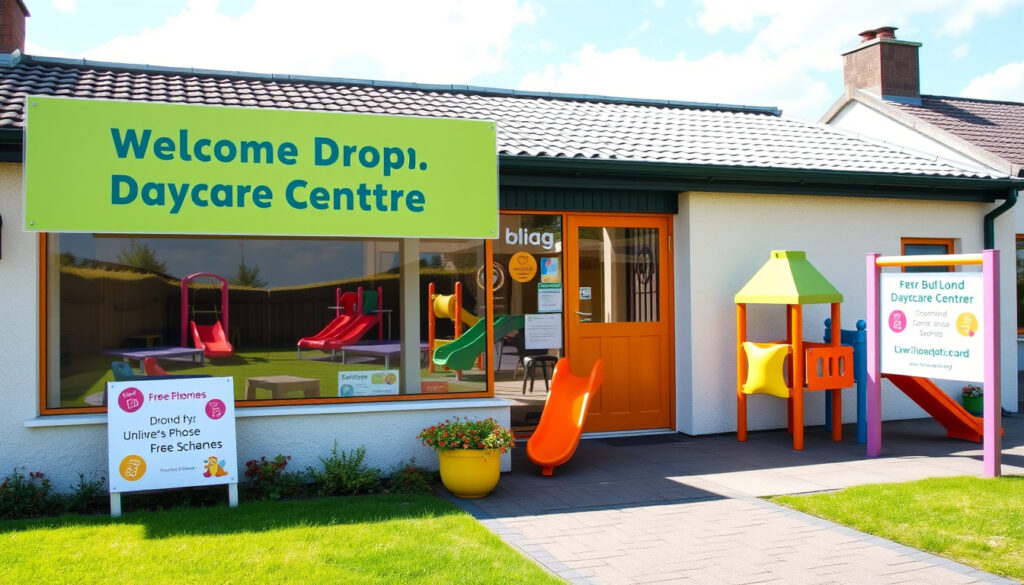
Drop In Daycare Near Me: Ireland Options & Free Schemes
Juggling work commitments while managing a young child often means scrambling for reliable childcare at the last minute. Drop-in daycare — flexible, session-based childcare for hours or half-days — can be a lifeline for parents who need occasional coverage without committing to a full-time contract. This guide maps out the drop-in creche landscape in Ireland, explains which government schemes can reduce what you pay, and flags what quality signals matter when you’re choosing somewhere fast.
Free childcare hours for 3-4 year olds: 15 hours · Ireland free pre-school scheme available: HSE options · Drop-in creche for ages: 8 weeks to 6 years · National Childcare Scheme fees: Creche specific
Quick snapshot
- The NCS universal subsidy pays €2.14 per hour to all families regardless of income (HSE.ie)
- ECCE scheme offers free preschool for 3 hours/day, 5 days/week, 38 weeks/year (HSE.ie)
- Drop-in centres must be Tusla-registered for subsidies to apply (SpunOut.ie)
- Exact availability of dedicated drop-in creches nationwide — varies by location and demand (HSE.ie)
- Whether smaller towns have drop-in options beyond playgroup sessions (HSE.ie)
- Current 2026 subsidy rates — sources may reflect pre-2026 figures (HSE.ie)
- ECCE eligibility cutoff: child must be 2 years 8 months old by 31 August of the starting year (HSE.ie)
- ECCE runs 38 weeks per academic year (HSE.ie)
- NCS subsidies apply year-round with no seasonal break (HSE.ie)
- Use the childcare.ie search tool by town or Eircode to find registered providers (Childcare.ie national portal)
- Apply for NCS subsidies at ncs.gov.ie before enrolling (NCS official portal)
- Confirm ECCE eligibility with your chosen provider for 3 free hours daily (Childcare.ie national portal)
| Field | Value |
|---|---|
| Primary drop-in example | Westwood gym creche |
| Search tool | childcare.ie Eircode search |
| Free scheme | HSE pre-school (ECCE) |
| Age range typical | Babies to preschoolers |
| NCS universal subsidy | €2.14/hour |
| NCS income-assessed max | €5.10/hour |
| ECCE daily hours | 3 hours |
| ECCE annual weeks | 38 weeks |
| NCS max hours (working) | 45/week |
| NCS eligibility | 24 weeks to 15 years |
| Tusla registration | Required for subsidies |
| ECCE min age | 2 years 8 months by 31 Aug |
What free childcare is available in Ireland?
Ireland operates two major government programmes that can chip away at creche costs: the National Childcare Scheme (NCS) and the Early Childhood Care and Education (ECCE) scheme. Both are administered through the HSE and can be combined, which means a family using a Tusla-registered provider may pay significantly less than the listed fee.
Childcare options and free pre-school scheme – HSE
According to the HSE, full-time childcare options include nursery, creche, and registered childminders. Drop-in centres are listed as part-time options offering short periods of care, sometimes found in community spaces or shopping centres. The ECCE scheme specifically provides free preschool for children aged 2 years and 8 months upward, giving 3 hours of free care daily, 5 days a week, for 38 weeks each year. All children are entitled to 2 full academic years on ECCE. Providers may charge separately for meals or extended hours beyond the free block.
ECCE covers only the school term. During summer holidays or mid-term breaks, you’re back to paying full rates unless you have NCS subsidies running. Plan your budget around the 38-week calendar, not a full year.
Does Ireland have free daycare?
Technically, Ireland does not offer completely free full-time daycare. What it does offer is targeted free preschool through ECCE — 3 hours per day, which is useful for parents of 3-year-olds but does not cover a full working day. The NCS universal subsidy of €2.14 per hour is available to all families regardless of income, which reduces costs but does not eliminate them. Families with lower incomes may qualify for the income-assessed rate of up to €5.10 per hour, and those earning under €26,000 annually receive the maximum subsidy rate.
Do I have to pay for my 3 year old to go to nursery?
If your child is in the ECCE age range (typically 3 years old), you receive 3 free hours per day at a participating Tusla-registered provider. You do not have to pay for those hours. However, nursery fees for care beyond the 3 free hours — before 9am, after noon, or on days outside term time — are charged at the provider’s standard rate.
15 hours free childcare for 3 and 4-year-olds – GOV.UK
Note that 15 hours free childcare is a UK policy and does not currently apply in Ireland. Irish parents should focus on the ECCE 3 hours daily (equivalent to 15 hours per week across 5 days) as the primary free entitlement. Mixing ECCE with NCS subsidies can meaningfully reduce the weekly bill — but not to zero.
How many hours do you get free for a 3 year old?
ECCE provides 3 hours per day of free preschool, Monday through Friday, for 38 weeks per year. That is roughly 15 hours of free care per week during term. The NCS adds a layer of subsidy for additional hours: working or studying parents can claim up to 45 subsidised hours per week under the income-assessed track, while those not currently working receive 20 subsidised hours per week.
The NCS and ECCE work independently — using ECCE does not reduce your NCS entitlement. If your child is in ECCE for 3 hours daily and you need 8 hours of total care, the NCS subsidy applies to the remaining 5 hours. Run the numbers at ncs.gov.ie before enrolling.
How much is childcare per hour in Ireland?
Hourly rates for creche care in Ireland depend on the provider, the child’s age, and whether any subsidies apply. Without subsidies, full-day care for under-2s at larger urban creches tends to run between €50 and €70 per day. Sessional care (around 3 hours) typically costs €15–€25 per session.
What Parents Can Expect to Pay: Average Hourly Childcare Costs
Grovelands Childcare in Dublin charges €900 per month for full-day care covering 0–2 year olds (5 days, 8 hours daily). For 3-year-olds, the rate drops to €770 per month under the same schedule. Sessional care for the 2–3 age group costs €442 per month (5 days, 3 hours), which translates to approximately €6.80 per hour at Grovelands. Little Hands Childcare in Cork lists full-day care at €220 per week for the 7.45am–5.30pm window. These are tier-3 commercial sources — prices can vary considerably by region and provider.
How much is a creche per week in Ireland?
Weekly fees vary by provider and contract type. At Grovelands, the monthly fee for under-2s breaks down to roughly €900 across four weeks — about €180 per week. Little Hands in Cork charges €220 per week for full-day care. When NCS subsidies are applied, the effective cost drops: a family earning under €26,000 with one child in creche could see their hourly rate reduced from €6.80 to under €1.70 per hour on subsidised hours, depending on income assessment.
The pattern: Dublin-area creches tend to command higher list prices, while Cork and smaller towns show more variable rates. The most reliable way to compare is to request a fee schedule directly from Tusla-registered providers in your area and subtract any NCS subsidies you qualify for.
Is a nanny cheaper than nursery?
The short answer is: usually not, once you factor in employer PRSI, sick pay obligations, and the reality that a nanny covers only your children versus a creche that distributes costs across many families. However, the comparison depends heavily on how many hours you need and whether you have multiple children.
Nanny Or Nursery? Does a Nanny Cost Much More? – Abode Staff
Industry analysis from recruitment agencies serving Irish households suggests that a full-time nanny costs a minimum of €35,000–€45,000 per year in base salary before employment-related costs. A creche for one child at €900 per month equals roughly €10,800 per year — significantly cheaper on paper. However, nannies offer convenience (your home, your schedule), and a family with two or three children in creche simultaneously may find the combined creche bill approaches or exceeds nanny costs.
The trade-off: creche provides socialisation for children and structured learning environments. A nanny offers flexibility and personalised care but at a premium. For parents needing only occasional drop-in hours, a gym creche or community drop-in is almost always cheaper than employing a nanny for those sessions.
Nannies make sense for families needing over 40 hours of weekly care with multiple young children. Drop-in creche makes sense for occasional or flexible coverage — and subsidies apply to creche fees in ways they don’t to nanny wages.
What are red flags in daycare?
Choosing a creche — especially a drop-in centre you may not have visited before — requires knowing what warning signs to watch for. The following signals suggest a provider may not meet adequate standards for health, safety, or developmental care.
How Do I Spot the Hidden Red Flags of a Bad Daycare?
Industry guidance and parenting advice publications identify several consistent red flags. High staff turnover is a primary concern: if the same faces have not been there for more than a year, it suggests low pay or poor management, both of which affect continuity of care for your child. Ask about staff qualifications and whether a qualified early childhood educator is always on site.
Unclean or overcrowded spaces are a structural red flag. Children need adequate floor space, clean toilet facilities, and age-appropriate equipment. If the play area feels cramped or smells of damp, move on. Limited outdoor access is another concern: reputable providers should offer outdoor play daily, weather permitting.
Poor communication from management — no written policies on illness, allergies, complaints, or emergency procedures — is a warning sign of informal operations. Any Tusla-registered provider should have these documents readily available for inspection. Finally, observe how children behave during your visit: signs of distress, lack of engagement, or minimal interaction with staff may indicate understaffing or inadequate programming.
The implication: visiting before committing gives you the clearest picture of day-to-day operations, not just what the brochure promises.
| Provider (example) | Location | Full-day rate (0–2 yrs) | Full-day rate (3+ yrs) | Sessional rate |
|---|---|---|---|---|
| Grovelands Childcare | Dublin | €900/month | €770/month | €442/month (2–3 yrs) |
| Little Hands Childcare | Cork | €220/week | €155.50/week (with ECCE) | Free (ECCE session) |
| Westwood Gym Creche | Dublin | Member rates apply | Member rates apply | Short-session availability |
| Model Farm Road Childcare | Cork | Varies by enquiry | Varies by enquiry | Varies by enquiry |
Upsides
- ECCE provides 3 free hours daily for children 2y8m and older
- NCS subsidies apply regardless of employment status (20–45 hrs/week depending on circumstances)
- Drop-in creches at gyms offer short-session flexibility without long-term contracts
- childcare.ie provides a searchable directory of Tusla-registered providers nationwide
- NCS calculator at ncs.gov.ie helps estimate exact subsidy amounts before enrolling
Downsides
- Drop-in availability varies significantly by location — rural areas have fewer options
- ECCE covers only 38 weeks per year; holiday gaps require full payment
- Grovelands charges €900/month for under-2s before subsidies
- Not all creches accept drop-in bookings without an existing full-time contract
- NCS subsidies require separate application through MyGovID and child’s PPSN
Finding and Booking Drop-in Daycare: A Step-by-Step Process
Securing drop-in childcare in Ireland involves locating a Tusla-registered provider, confirming their drop-in availability, and applying for subsidies where eligible. Each step has specific tools and requirements.
Locate registered providers: Use the childcare.ie directory at Childcare.ie (national childcare funding portal). Enter your county or Eircode to filter by location. Check the registration status of each provider — only Tusla-registered creches qualify for NCS and ECCE subsidies.
Confirm drop-in availability: Call or email the provider directly. Many larger creches reserve limited drop-in slots for existing families or regular users. Gym creches (such as Westwood) often allow non-members to book sessions for an additional fee. Ask specifically about hourly versus sessional bookings.
Check ECCE eligibility: If your child is 2 years 8 months or older, verify whether the provider participates in ECCE. This gives you 3 free hours daily during term. Confirm whether meals or extended hours are charged separately.
Apply for NCS subsidies: Visit NCS.gov.ie (official National Childcare Scheme portal) to apply using your MyGovID. Have your child’s PPSN ready. The portal includes a subsidy calculator that estimates your hourly rate reduction based on income and hours needed. Subsidies are paid directly to the provider — you should not be paying the full unsubsidised rate.
Book and confirm pricing: Request a written fee schedule from the provider. Confirm whether their quoted rate is before or after NCS subsidies. At Grovelands, for example, the listed monthly fee does not include NCS reductions — families must apply separately to see the net cost after subsidies.
What’s confirmed and what’s still unclear
What experts and official sources say
A universal subsidy is available to all families. It is not means-tested.
— HSE official childcare guidance
The rates for income-assessed subsidies are higher than the universal rate and can reach up to €5.10 per hour.
All families will be able to get this minimum of 50c per hour towards childcare for the above age groups — regardless of income.
For parents in Ireland, the path to affordable drop-in childcare runs through two government schemes and one practical tool: check your ECCE eligibility first, apply for NCS subsidies at ncs.gov.ie, and use childcare.ie to find Tusla-registered providers near you. The combination can reduce what you pay substantially — but the exact savings depend on your income, your child’s age, and whether your provider participates in both programmes.
What to say at daycare drop off?
Keep the goodbye brief and warm. A simple “Mummy/Daddy is going now, I’ll be back after lunch” gives the child a clear timeline without extended emotional moments that can heighten anxiety. Ask the staff what information they need about the child’s morning — sleep, food, mood — and write it down if you tend to forget details during a rushed morning.
What is the 3-3-3 rule for children?
The 3-3-3 rule is a childcare guideline suggesting children under 3 years old can safely manage up to 3 consecutive hours away from parents, up to 3 times per week. It is an informal benchmark used by some parenting resources, not an official HSE or NCS standard. In practice, the appropriate duration of drop-in care depends on the individual child’s temperament, familiarity with the setting, and the quality of the provider.
Are there drop in creche options in Dublin?
Yes. Dublin has several options including Westwood gym creche (serving members and non-members), larger creches that accommodate drop-in bookings subject to availability, and community drop-in centres in areas like Fingal and South Dublin. Gym creches typically serve children from 8 weeks to 6 years. Use childcare.ie to search by Eircode for the most current availability near you.
What community creche options exist near me?
Community creches vary by county. Your City or County Childcare Committee (CCC) maintains local provider listings and can advise on community-based options. The childcare.ie search tool allows filtering by county, and Tusla’s register is publicly searchable. Playgroups and Naíonraí (Irish-language preschool groups) often function as part-time drop-in alternatives, though they may not offer full-day care.
How does ECCE work with part-time attendance?
ECCE provides free preschool for 3 hours per day at participating Tusla-registered providers. Part-time use is straightforward: if your child attends for exactly the ECCE window, the 3 hours are free. Any additional hours beyond the 3-hour block are charged at the provider’s standard sessional or hourly rate. Sessional care for 2–3 year olds at Grovelands, for example, costs €442 per month on top of any ECCE hours used.
Where can I find a gym with creche facilities?
Large leisure centres and gyms in Irish cities commonly operate creche facilities for members. Westwood.ie is one documented example in Dublin. Many more exist — search “gym with creche [your county]” or check the facilities listings on your local council’s recreation website. Gym creches are typically open during gym operating hours and offer shorter sessions than full creches, making them suitable for drop-in needs.
Related reading: Thrift Shops Near Me in Ireland: Charity Shops Guide · Primary Care Doctors Near Me – How to Choose the Right One
More related posts
 Known Traveler Number Lookup: Find Your KTN Fast
 Time Person of the Year 2025: Architects of AI
 How to Stretch Hip Flexors: Techniques and Common Mistakes
 Where to Watch FC Barcelona vs Real Madrid: Live Streams & Channels
 How to Make Banana Bread: Moist Recipe Guide
 Post Office Passport Appointment: Do You Need One?
 Women’s Cricket World Cup Standings 2025: Points Table & Qualifiers
 54 Inches in Feet: Exact Conversion & Common Mistakes