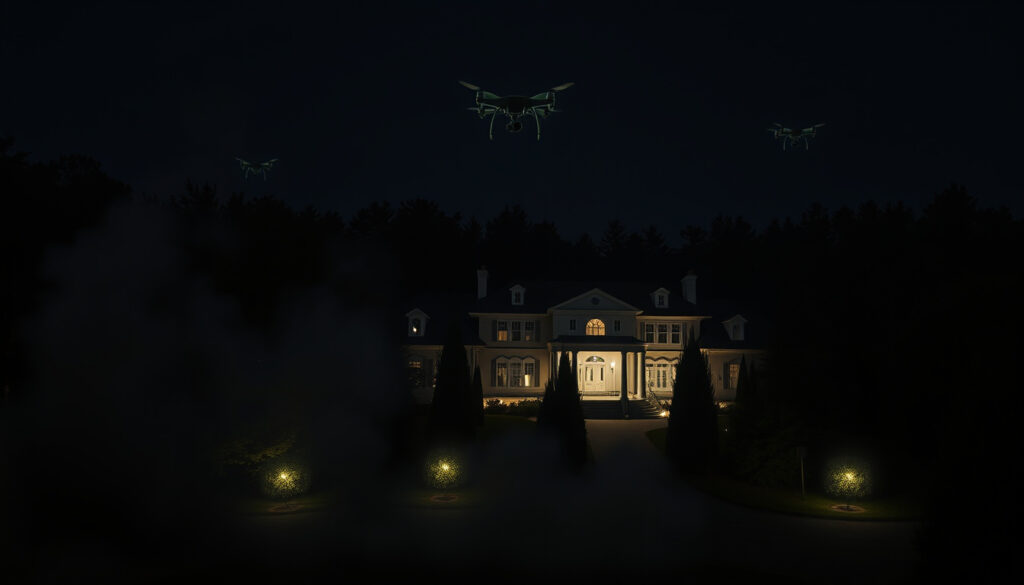
Attack on Putin Residence: Russia Claims Drones, Denied by Ukraine
On the night of December 29, 2025, Russia’s Defense Ministry issued a startling claim: 91 Ukrainian drones had swept across the country’s northern regions toward a presidential compound near Valdai. Within days, the narrative fractured along geopolitical lines—Moscow presented it as an assassination attempt, while the CIA privately concluded something quite different.
Drones claimed: 91 UAVs · Date: Dec 29–30, 2025 · Location: Valdai area, Novgorod region · Trump assessment: Jan 5, 2026
Quick snapshot
- 91 drones launched toward Putin residence (The Moscow Times)
- 91 total, 50 intercepted over Bryansk and Smolensk regions (The Moscow Times)
- Whether attack actually targeted Putin residence (Novaya Gazeta)
- No independent verification of video evidence (The Moscow Times)
- Dec 30: Russia issues claim (The Moscow Times)
- Jan 5: Trump reverses position after CIA briefing (Matt Bivens Substack)
- Russia handed drone controller to U.S. attaché Jan 2 (Russian Defense Ministry YouTube statement)
- Impact on U.S.-brokered peace negotiations remains uncertain (The Moscow Times)
The key facts table below summarizes the official claims and denials surrounding the December 2025 incident.
| Detail | Value |
|---|---|
| Event date | December 29–30, 2025 |
| Claimed drones | 91 long-range UAVs |
| Residence | Valdai presidential compound |
| Intercepts in Bryansk/Smolensk | 50 drones (520 km south) |
| Intercepts in Novgorod | 41 drones (revised from 18) |
| Key denials | Ukraine, CIA, multiple residents |
Did Ukraine Attack Putin’s Residence?
Russia’s Defense Ministry claimed on December 30, 2025, that Ukraine launched 91 long-range drones targeting President Vladimir Putin’s residence near Valdai, a lake-side compound in the Novgorod region roughly 400 kilometers north of Moscow. Foreign Minister Sergey Lavrov called it a “terrorist attack” and announced Russia would revise its negotiating stance on peace talks underway with U.S. mediation. Ukraine immediately denied the accusation, with President Volodymyr Zelensky framing it as a Kremlin effort to derail those same negotiations.
The U.S. intelligence community reached a different conclusion. The CIA assessed that Ukrainian drones were targeting a military facility in the Novgorod region, not the presidential residence. U.S. Ambassador to NATO Matthew Whitaker stated that Western intelligence agencies were still examining Russia’s claims and that uncertainty remained about whether the attack had actually occurred.
Russian Claims
Major General Alexander Romanenkov, head of Russia’s aerospace forces air defense missile troops, provided a detailed briefing claiming drones traveled along multiple routes passing over Bryansk, Smolensk, Tver, and Novgorod regions before destruction. The Defense Ministry initially reported downing only 18 drones in the Novgorod region between Sunday and Monday, later revising that figure to 41. The ministry released video footage and testimony from a local resident, Igor Bolshakov, claiming he heard explosions during the alleged attack.
Admiral Igor Kostyukov, chief of Russia’s military intelligence, presented a decrypted drone navigation controller to a U.S. military attaché on January 2, 2026, as evidence of Ukrainian involvement.
Russia’s Defense Ministry revised its reported drone count for Novgorod region from 18 to 41 between announcements—a detail that complicated the official narrative.
Ukraine Denial
Ukraine dismissed the allegations as disinformation. Zelensky stated his negotiating team had discussed the claims with U.S. officials, noting: “Our partners can verify whether this was fabricated, given their technical capabilities.” The Ukrainian position maintained that Russia was manufacturing a provocation to justify walking away from peace talks, which had shown some progress in late December 2025.
CIA Assessment
According to U.S. intelligence cited by Novaya Gazeta, the CIA concluded drones were targeting a military facility in Novgorod, not Putin’s residence. CIA Director John Ratcliffe briefed President Trump on January 5, 2026. After that meeting, Trump publicly stated: “I don’t believe that strike happened. We don’t believe that happened, now that we’ve been able to check.” He later reposted a New York Post article titled “Putin attack bluster shows Russia is the one standing in the way of peace.”
Where Is Putin’s Residence Located?
The Valdai presidential compound sits near Lake Valdai in the Novgorod region, approximately 400 kilometers north of Moscow. Known internally as “Ujin,” the compound is one of several guarded residences linked to Putin throughout Russia. Unlike the Kremlin—a heavily fortified urban complex—the Valdai site is isolated in a forested lakeside area.
Valdai Presidential Residence
The residence gained international attention after the December 2025 claims. According to reporting by the Matt Bivens Substack, Putin’s long-time associate Alina Kabayeva and their two sons, Ivan (approximately 11) and Vladimir (approximately 7), reportedly spend most of their time at the Valdai property. One account suggests air defenses around the Valdai compound are equivalent to roughly one-fifth of Moscow’s air defense capacity.
Novgorod Region Details
Novgorod region sits between Russia’s major population centers and the Baltic states. The area has seen previous military activity since Russia’s full-scale invasion of Ukraine began in February 2022. The distance from intercept zones in Bryansk and Smolensk to Valdai measures approximately 520 kilometers—a figure Russian officials cited when explaining how they tracked and destroyed drones across multiple regions.
What this means: the Valdai compound, while remote, falls within range of Ukrainian long-range drone capabilities that have targeted Russian territory throughout the conflict.
What Percent of Russia Supports Putin?
Polling data consistently shows high approval ratings for Vladimir Putin within Russia, though independent surveying has become increasingly difficult since the 2022 invasion and subsequent restrictions on civil society. State-affiliated polls have frequently reported approval ratings above 75%, while independent analysts note significant limitations in measuring public opinion under current conditions.
Polling Data
Multiple factors complicate understanding Russian public sentiment. Independent Russian polling organizations have faced shutdowns or exile, and Russians who express dissent increasingly risk prosecution under laws criminalizing “discrediting” the military. The Russian government controls most domestic media, creating an information environment where critical voices are largely absent.
Public Image Context
Putin has cultivated a public image emphasizing stability, national strength, and traditional values. The Valdai compound—occasionally glimpsed in state media—projects an image of rustic simplicity contrasting with Western portrayals. Whether this resonates with ordinary Russians facing economic pressures and battlefield casualties remains difficult to assess independently.
The catch: without independent polling, any figure on Russian public support for Putin carries substantial uncertainty.
Who Is Putin’s Best Friend?
Russian President Vladimir Putin has cultivated a carefully controlled public image with limited public personal life. Cellist Sergei Roldugin has been identified in the “Panama Papers” leak as a close associate, with financial records suggesting complex asset networks involving Putin’s inner circle. The relationship exemplifies how Putin’s personal connections often intersect with questions of wealth and influence.
Sergei Roldugin
Roldugin, a professional musician, became internationally known through investigative reporting examining documents from the Panamanian law firm Mossack Fonseca. The leaks suggested Roldugin served as a conduit for offshore financial flows involving billions of dollars, though he publicly maintained he was merely a “steward” of assets belonging to others. Putin has publicly acknowledged Roldugin as a personal friend from their shared time in Saint Petersburg.
Personal Ties
Beyond Roldugin, Putin’s circle includes former KGB colleagues, Saint Petersburg associates, and security officials who have risen to top positions during his presidency. The structure of these relationships—whether personal loyalty, mutual financial interest, or institutional dependency—remains a subject of analysis rather than definitive knowledge.
Why this matters: the opacity surrounding Putin’s personal relationships reflects the broader opacity of Russian governance, where distinguishing between state interests and personal patronage networks proves challenging.
What Happened to Putin’s Family?
Vladimir Putin’s family life has been a subject of intense speculation given his carefully guarded privacy. His public statements about family members are rare, and information about their activities comes primarily from unofficial sources, investigative journalism, and occasional state media glimpses.
Wife Lyudmila
Putin and Lyudmila Putina announced their divorce in 2014 after three decades of marriage. The divorce coincided with a period of increased international scrutiny following Russia’s annexation of Crimea. Lyudmila subsequently married Arthur Obreztsov, a former university classmate, in a ceremony largely absent from Russian state media.
Daughter Katerina
Putin has two daughters from his marriage to Lyudmila: Maria Vorontsova and Katerina Tikhonova. Both have pursued careers in science and academia, though their names frequently appear in connection with Russian technology initiatives and foundations. U.S. sanctions have targeted both women, with Treasury officials citing their roles in companies receiving state funding. Tikhonova has been described in Western reporting as leading research into human longevity—a field that has attracted attention given Putin’s known interest in extending his political longevity.
What this means: Putin maintains strict separation between his public role and private family, making verifiable information scarce and speculation widespread.
Timeline of Events
The following timeline tracks the key developments from the May 2023 Kremlin incident through the January 2026 CIA briefing.
| Date | Event |
|---|---|
| May 2023 | Two drones strike Kremlin roof; Russia calls it assassination attempt |
| Dec 29, 2025 | Ukrainian drones reportedly cross Russian airspace |
| Dec 30, 2025 | Russia claims 91-drone attack on Putin’s Valdai residence |
| Dec 31, 2025 | Ukraine denies attack; calls it Russian disinformation |
| Jan 2, 2026 | Russia hands drone controller to U.S. military attaché |
| Jan 5, 2026 | CIA briefs Trump; he states strike “didn’t happen” |
The pattern: Russia has previously characterized drone incidents as assassination attempts, only to face denials and conflicting intelligence assessments.
The December 2025 claims echoed a May 2023 incident when drones struck the Kremlin roof. Russia characterized that event as an assassination attempt, though Ukraine denied responsibility.
What the Evidence Shows
Confirmed
- Russia’s Defense Ministry issued the 91-drone claim
- 50 drones intercepted over Bryansk and Smolensk regions
- 41 drones (revised from 18) intercepted in Novgorod region
- Ukraine publicly denied launching the attack
- Lavrov characterized the claim as a “terrorist attack”
- Zelensky said Russia was trying to disrupt peace talks
- CIA assessed drones targeted a military facility, not residence
- Trump stated after briefing he did not believe strike occurred
Unclear
- Whether attack actually targeted Putin’s residence
- Whether attack occurred as described
- Whether Valdai residents heard explosions (multiple reported hearing nothing)
- What specific military facility was targeted
- Whether video evidence can be independently verified
- Whether drone controller evidence proves Ukrainian involvement
More than a dozen Valdai residents reported hearing nothing between Sunday night and Monday morning—directly contradicting official Russian claims of an intensive aerial assault.
Bottom line: The incident reveals how Russia’s willingness to weaponize allegations creates political pressure regardless of factual basis, while the CIA’s quick conclusion suggests confidence in technical intelligence—though that assessment remains classified.
Official Statements and Reactions
“I don’t believe that strike happened. We don’t believe that happened, now that we’ve been able to check.”
— President Donald Trump, January 5, 2026, after CIA briefing
“Our partners can verify whether this was fabricated, given their technical capabilities.”
— Ukrainian President Volodymyr Zelensky, on the need for U.S. verification of Russian claims
“It was a terrorist attack… Russia will revise its negotiating stance.”
— Russian Foreign Minister Sergey Lavrov
Aleksei Chepa, deputy chair of the Russian State Duma’s Committee on International Affairs, stated the attack would have been impossible without Western intelligence support—a claim that aligns with Moscow’s broader narrative blaming the United States for directing Ukrainian military operations.
U.S. Ambassador to NATO Matthew Whitaker offered a more cautious assessment, noting Western intelligence agencies were still examining the claims and that it remained unclear whether the attack had actually occurred.
For Western policymakers and analysts, the incident illustrates a familiar challenge: Russia’s willingness to weaponize allegations, creating political pressure regardless of factual basis. The CIA’s quick conclusion that drones targeted a military facility rather than the president suggests confidence in technical intelligence—but that assessment remains classified.
Bottom line: The asymmetry between Russia’s public claims and the CIA’s private assessment underscores how competing narratives shape diplomatic negotiations, with implications for U.S.-brokered peace talks.
Related reading: House Vote on Government Shutdown · Stimulus Check 2025 Update
Frequently Asked Questions
Did Ukraine actually attack Putin’s residence?
Ukraine denies launching any attack on Putin’s residence. The CIA assessed that drones targeted a military facility in the Novgorod region, not the presidential compound. President Trump stated on January 5, 2026, that he did not believe the strike occurred.
What is the Valdai residence?
The Valdai presidential compound sits near Lake Valdai in the Novgorod region, approximately 400 kilometers north of Moscow. Known internally as “Ujin,” the isolated lakeside property is one of several guarded residences linked to Putin throughout Russia.
How many drones were involved according to Russia?
Russia’s Defense Ministry claimed Ukraine launched 91 drones, with 50 intercepted over Bryansk and Smolensk regions and 41 intercepted in Novgorod. The ministry initially reported only 18 drones downed in Novgorod before revising the figure.
What did the CIA conclude about the attack?
U.S. intelligence assessed that drones targeted a military facility in the Novgorod region, not Putin’s residence. CIA Director John Ratcliffe briefed President Trump on January 5, 2026, after which Trump publicly stated he did not believe the strike occurred.
What evidence did Russia provide?
Russia released video footage and testimony from a local resident claiming to have heard explosions. Admiral Igor Kostyukov presented a decrypted drone navigation controller to a U.S. military attaché on January 2, 2026. However, the video footage did not include details allowing independent verification of when or where it was recorded.
How did the incident affect peace negotiations?
Russian Foreign Minister Lavrov stated Russia would revise its negotiating stance following the alleged attack. Ukraine maintained the claims were disinformation designed to disrupt U.S.-brokered peace talks that had shown progress in late December 2025.
Were there any civilian witnesses to the attack?
More than a dozen Valdai residents reported hearing nothing between Sunday night and Monday morning, directly contradicting Russia’s account of intensive aerial combat near the presidential compound.
More related posts
 Mayo Clinic Patient Portal: Login, Sign Up, and Features
 Real Housewives of Rhode Island Season 2: Renewal & Cast Shake-Up
 Cast of The Other Zoey: Full List & Streaming Details
 Detroit Pistons vs Memphis Grizzlies Match Player Stats
 USCIS Electronic Payment Mandate Effective Oct 28, 2025
 US Economy News Today: GDP, Inflation & Recession Outlook
 Taste of the Wild Dog Food: Safety, Controversy & Value
 Crispy Air Fryer Potato Wedges: Time, Temp & Tips