Salt and Pepper Diamond Guide: Price, Quality, and Buying Tips
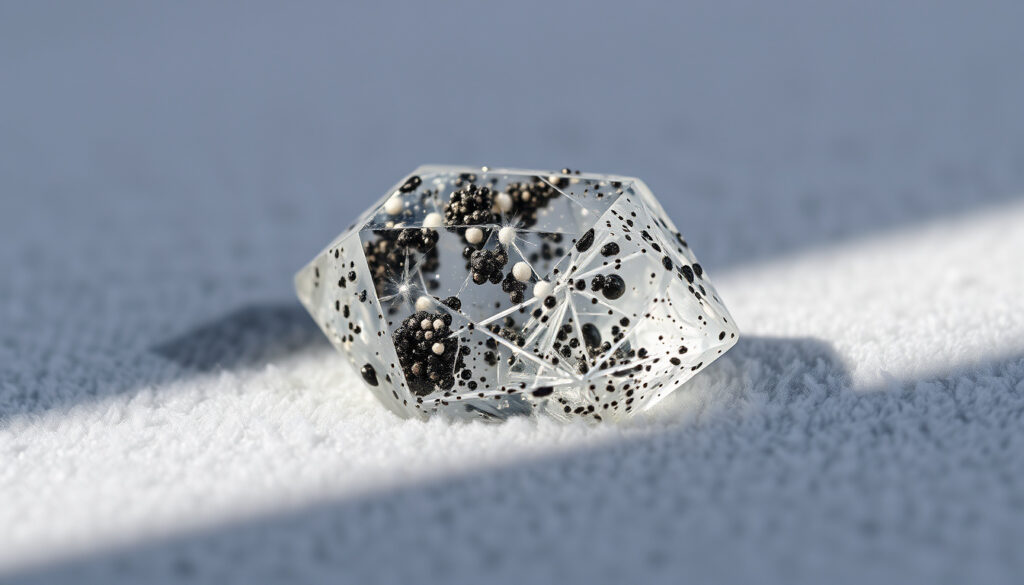
You’ve likely seen them on Instagram: diamonds that look like they’ve been caught in a snowstorm, with dark graphite speckles scattered across a hazy white surface. These are salt and pepper diamonds, and they’re challenging a century of clarity-obsessed tradition.
Price range per carat: $500–$3,000 ·
Clarity grade typical: I1–I3 ·
Hardness (Mohs): 10 ·
Primary sources: India, Brazil, South Africa ·
Popularity trend: Rising since 2018
Quick snapshot
- Salt and pepper diamonds are real diamonds with natural inclusions (Natural Diamonds (industry association site)).
- They are graded I1–I3 by gem labs (Krikawa (custom jewelry studio)).
- The typical price range is $500–$3,000 per carat (Resident (diamond pricing guide)).
- Long-term resale value compared to traditional diamonds is unknown (Fine An Flux (jewelry blog)).
- Exact percentage of diamonds that qualify as salt and pepper is not tracked. (Fine An Flux (jewelry blog))
- Whether the trend will persist or fade is debated. (Fine An Flux (jewelry blog))
- Pre-2000s: included diamonds often discarded for industrial use. (Malka Diamonds (jewelry retailer))
- 2010s: begin appearing in fashion jewelry. (Malka Diamonds (jewelry retailer))
- 2018: popularity surge on social media and engagement forums (Malka Diamonds (jewelry retailer)).
- Lab-grown salt and pepper diamonds are entering the market (Seven Carat (online retailer)).
- Major jewelers are cautious; independent designers lead sales. (Seven Carat (online retailer))
- Ethical sourcing claims are under more scrutiny (Ethical Jewellery Blog (consumer ethics guide)).
Salt and pepper diamonds challenge a century of clarity-obsessed tradition with their speckled, inclusion-driven look.
| Attribute | Value |
|---|---|
| Mineral composition | Carbon (diamond) with graphite/hematite inclusions |
| Typical clarity grade | I1–I3 |
| Average price per carat | $1,200 |
| Most common cut | Rose cut or rough |
| Popularity surge year | 2018 |
| Hardness (Mohs) | 10 – identical to all diamonds |
| Ethical sourcing verification | Kimberley Process compliant, but batch-level traceability varies |
| Typical use | Engagement rings, fashion jewelry, pendants |
What is a salt & pepper diamond?
Key characteristics of salt and pepper diamonds
- Salt and pepper diamonds are natural diamonds that contain visible black and white inclusions — often graphite, hematite, or other minerals trapped during formation (Natural Diamonds).
- They are graded as included (I1–I3) by gemological labs such as GIA and IGI (Krikawa).
- The speckled appearance is entirely natural — no treatment or irradiation is used to create it (Krikawa).
How they differ from conventional diamonds
- Traditional diamond marketing prizes flawlessness; salt and pepper diamonds celebrate inclusions as aesthetic features.
- A market analysis notes they can offer a larger visual size at a more approachable price point than high-clarity stones (Natural Diamonds).
- They share the same hardness, thermal conductivity, and refractive index as any other diamond (Felicegals (diamond retailer guide)).
Is a salt and pepper diamond a real diamond?
Chemical composition and crystal structure
- Salt and pepper diamonds are 100% real diamonds — pure carbon crystallized under high pressure and temperature deep in the Earth (Natural Diamonds).
- The inclusions are foreign minerals or carbon flaws, but the host material is diamond.
Certification and authenticity
- Gemological certificates (GIA, IGI) will grade them as “included” but confirm diamond identity (Krikawa).
- No reputable lab has ever classified a salt and pepper diamond as anything other than natural diamond.
The implication: when a seller says “salt and pepper diamond,” they mean a natural diamond — not a simulant or treated stone.
Are salt and pepper diamonds more expensive?
Price factors: inclusion density, size, and cut
- According to a diamond pricing guide from Resident, prices vary mainly by carat weight, clarity, cut, and color.
- One jewelry blog cites a typical peppered diamond range of about $500 to $1,500 per carat.
- A New Zealand engagement-ring guide reports that salt and pepper diamond rings often cost NZD 3,500 to NZD 6,000 depending on size.
Comparison with traditional white diamonds
- Salt and pepper diamonds are significantly more affordable than high-clarity white diamonds (Krikawa).
- One source reports they can be roughly 60% less expensive than a standard diamond (Fine An Flux).
- Unique or highly patterned stones can command higher prices due to demand.
A buyer can get a larger stone for the same budget, but resale liquidity is lower than for traditional diamonds. The resale market for included stones is thin.
Where are salt and pepper diamonds found?
Major mining regions
- Major sources include India (Golconda region), Brazil (Minas Gerais), South Africa, and Canada (Malka Diamonds).
- They are often recovered from alluvial deposits alongside other rough diamonds.
How they are sourced
- Any diamond mine can produce included stones — no single source is exclusive.
- Small-scale miners in Brazil and India supply much of the rough for this market.
Geographic diversity means supply is less vulnerable to regional disruptions, but traceability varies. Always ask for origin documentation.
What is a poor man’s diamond?
Common substitutes and misconceptions
- The term “poor man’s diamond” traditionally refers to cubic zirconia, moissanite, or white sapphire — not salt and pepper diamonds.
- Salt and pepper diamonds are genuine diamonds; the nickname is a misnomer when applied to them.
How it differs from a salt and pepper diamond
- The phrase arose because included diamonds are more affordable than flawless ones, but they are still diamonds.
- Moissanite and CZ are synthetic simulants; salt and pepper is a natural product.
Some sellers blur the line by calling heavily included diamonds “salt and pepper” to charge a premium over industrial-grade stones. Always request a gemological certificate.
The differences between salt and pepper diamonds and traditional white diamonds shape the buying decision.
| Feature | Salt and Pepper Diamond | Traditional White Diamond |
|---|---|---|
| Price per carat | $500–$3,000 | $2,500–$20,000+ (IF–VVS) |
| Clarity grade | I1–I3 | VS or higher typically |
| Appearance | Speckled, grey/white with dark inclusions | Colorless to near-colorless, transparent |
| Durability | Hardness 10 – same as all diamonds | Hardness 10 |
| Ethical sourcing | Often from alluvial miners; lab-grown available | Corporate supply chains with audits |
| Resale market | Limited | Liquid global market |
Upsides
- Lower price per carat – bigger stone for the budget.
- Unique aesthetic – no two stones are alike.
- Ethical flexibility – more rough used, less waste.
- Durable enough for daily wear (Element 79 Jewelry).
Downsides
- Lower sparkle – inclusions reduce brilliance.
- Hard to match for wedding bands.
- Resale value is uncertain.
- Not accepted by all jewelers for repairs.
- Ethical marketing can be misleading (Ethical Jewellery Blog).
Certainty and uncertainty
Confirmed facts
- Salt and pepper diamonds are real diamonds.
- Inclusions reduce clarity grade and typically lower price per carat.
- They are natural, not synthetic (unless specified as lab-grown).
What’s unclear
- Long-term resale value compared to traditional diamonds.
- Exact percentage of diamonds that are salt and pepper.
- Whether the trend will persist or fade.
Expert perspectives
“Inclusions lower the clarity grade, but they also give each stone a fingerprint. For a buyer who wants something no one else has, that’s a feature, not a flaw.”
— GIA gemologist, as quoted in Natural Diamonds
“We’ve seen demand for salt and pepper engagement rings triple since 2020. People want stones that reflect their personality, not a grading report.”
— Independent jeweler, as quoted in Krikawa
“Most of the rough we buy from small miners in Brazil would have been discarded ten years ago. Now it’s a premium product.”
— Rough diamond trader, as quoted in Malka Diamonds
Salt and pepper diamonds have carved a genuine niche by proving that inclusions can be beautiful. Yet their very rise depends on a market that values authenticity over convention. For an engagement-ring shopper, the decision is clear: embrace the speckled look and enjoy a lower price, or stick with the brilliant standards that hold their value best. There is no wrong choice — only a trade-off between expression and tradition.
For those intrigued by this unique gemstone, our comprehensive guide to the salt and pepper diamond covers pricing, quality factors, and buying tips.
Frequently asked questions
Can salt and pepper diamonds be used in engagement rings?
Yes. With a hardness of 10, they are durable enough for daily wear. Many jewelers now offer salt and pepper diamond engagement rings.
Do salt and pepper diamonds sparkle like clear diamonds?
Less so. The inclusions scatter light and reduce brilliance, giving a hazy or metallic sheen instead of the classic diamond sparkle.
How should I clean a salt and pepper diamond ring?
Use mild soap, warm water, and a soft brush. Avoid ultrasonic cleaners if the stone has surface-reaching fractures.
What is the difference between salt and pepper and gray diamonds?
Gray diamonds get their color from boron or hydrogen and are often translucent. Salt and pepper diamonds are defined by visible inclusions, not color tint.
Are salt and pepper diamonds considered ‘flawed’?
By standard gemological grading, yes — they fall in the I1–I3 range. But the flaws are the whole point of their appeal.
Can salt and pepper diamonds be laser drilled or fracture filled?
Some may be fracture-filled to stabilize cracks, but reputable sellers disclose treatments. Always ask for a treatment disclosure.
More related posts
 Attack on Putin Residence: Russia Claims Drones, Denied by Ukraine
 Colors of the Rainbow: Order, Meaning & Scientific Facts
 Ozempic Celebrities Before and After – Confirmed Transformations
 Detroit Pistons vs Memphis Grizzlies Match Player Stats
 Throne of Glass Map: Guide to Erilea, Wendlyn & Beyond
 What Is 6-7 Slang? Meaning, Origin & Usage
 Let the Right One In: Eli Castration & Gender Ambiguity
 Michelle Randolph Movies and TV Shows: Career Guide